Showing posts with label John Henry Newman. Show all posts

Monday, April 6, 2026

Matthew Bridges

Matthew Bridges (1800—1894) is a poet and hymn-writer whose first book Jerusalem Regained: A Poem appeared in 1825 (L.B. Seeley and Son). He was an Anglican minister who at first wrote critically of Roman Catholicism. Under the influence of the Oxford Movement and John Henry Newman, he transferred his allegiance to the Catholic Church in 1848. His poetry collection, Babbicombe, or Visions of Memory, appeared in 1852.

Later in life he lived for several years in Quebec, but returned to England before he died.

The following hymn was written in 1851as a result of Bridges’ reflections on John’s Book of Revelation, including Revelation 19:12. The lyrics you see below are Bridges’ original version. In 1868, an Anglican priest named Godfrey Thring added six further verses to the hymn. The version you are likely familiar with has been distilled down to four verses —for printing in hymn books — from the earlier twelve.

Crown Him with Many Crowns

Crown him with many crowns,
The Lamb upon his throne;
Hark! how the heavenly anthem drowns
All music but its own:
Awake, my soul, and sing
Of him who died for thee,
And hail him as thy matchless king
Through all eternity.

Crown him the Virgin's Son!
The God Incarnate born,—
Whose arm those crimson trophies won
Which now his brow adorn!
Fruit of the mystic Rose
As of that Rose the Stem:
The Root, whence mercy ever flows,-
The Babe of Bethlehem!

Crown him the Lord of love!
Behold his hands and side, —
Rich wounds, yet visible above,
In beauty glorified:
No angel in the sky
Can fully bear that sight,
But downward bends his burning eye
At mysteries so bright!

Crown him the Lord of peace!
Whose power a scepter sways,
From pole to pole, —that wars may cease,
Absorbed in prayer and praise:
his reign shall know no end,
And round his pierced feet
Fair flowers of paradise extend
Their fragrance ever sweet.

Crown him the Lord of years!
The Potentate of time, —
Creator of the rolling spheres,
Ineffably sublime!
Glassed in a sea of light,
Where everlasting waves
Reflect his throne, —the Infinite!
Who lives, —and loves—and saves.

Crown him the Lord of heaven!
One with the Father known, —
And the blest Spirit, through him given
From yonder triune throne!
All hail! Redeemer, —Hail!
For Thou hast died for me;
Thy praise shall never, never fail
Throughout eternity!

Entry written by D.S. Martin. He is the author of six poetry collections including Angelicus (2021, Poiema/Cascade), plus three anthologies — available through Wipf & Stock. His new book The Role of the Moon, inspired by the Metaphysical Poets, is now available from Paraclete Press.

Monday, March 20, 2023

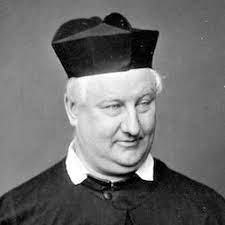
Frederick William Faber

Frederick William Faber (1814―1863) is best known as a theologian and hymnist. He was born in Yorkshire into a Calvinist family of Huguenot descent, but as a student at Oxford University became greatly influenced by John Henry Newman. During this time he took extended vacations in the Lake District, to write poetry, and wrestle through theological issues. There he was befriended by William Wordsworth.

While a student at Oxford, Faber won the Newdigate Prize for poetry, which has also been won by such poets as Matthew Arnold and Oscar Wilde. He was ordained in the Church of England in 1839, however, in 1845 both he and Newman left to join the Catholic Church.

As was common for 19th century Christian poets, Faber wrote much of his verse in the form of hymns. Perhaps his best-known is — ironically — “Faith of Our Fathers.” By the twentieth century, however, this hymn was being included in Protestant hymnbooks, and A.W. Tozer included twenty pieces by Faber in his anthology, The Christian Book of Mystical Verse (1963).

The Eternity of God

O Lord! my heart is sick,
Sick of this everlasting change;
And life runs tediously quick
Through its unresting race and varied range:
Change finds no likeness to itself in Thee,
And wakes no echo in Thy mute eternity.

Dear Lord! my heart is sick
Of this perpetual lapsing time,
So slow in grief, in joy so quick,
Yet ever casting shadows so sublime:
Time of all creatures is least like to Thee,
And yet it is our share of Thine eternity.

Oh change and time are storms,
For lives so thin and frail as ours;
For change the work of grace deforms
With love that soils, and help that overpowers;
And time is strong, and, like some chafing sea,
It seems to fret the shores of Thine eternity.

Weak, weak, for ever weak!
We cannot hold what we possess;
Youth cannot find, age will not seek, —
Oh weakness is the heart's worst weariness:
But weakest hearts can lift their thoughts to Thee;
It makes us strong to think of Thine eternity.

Thou hadst no youth, great God!
An Unbeginning End Thou art;
Thy glory in itself abode,
And still abides in its own tranquil heart:
No age can heap its outward years on Thee:
Dear God! Thou art Thyself Thine own eternity!

Without an end or bound
Thy life lies all outspread in light;
Our lives feel Thy life all around,
Making our weakness strong, our darkness bright;
Yet is it neither wilderness nor sea,
But the calm gladness of a full eternity.

Oh Thou art very great
To set Thyself so far above!
But we partake of Thine estate,
Established in Thy strength and in Thy love:
That love hath made eternal room for me
In the sweet vastness of its own eternity.

Oh Thou art very meek
To overshade Thy creatures thus!
Thy grandeur is the shade we seek;
To be eternal is Thy use to us:
Ah, Blessed God! what joy it is to me
To lose all thought of self in Thine eternity.

Self-wearied, Lord! I come;
For I have lived my life too fast:
Now that years bring me nearer home
Grace must be slowly used to make it last;
When my heart beats too quick I think of Thee,
And of the leisure of Thy long eternity.

Farewell vain joys of earth!
Farewell, all love that is not His!
Dear God! be Thou my only mirth,
Thy majesty my single timid bliss!
Oh in the bosom of eternity
Thou dost not weary of Thyself, nor we of Thee!

Entry written by D.S. Martin. He is the author of five poetry collections including Angelicus (2021, Cascade) ― a book of poems written from the point-of-view of angels. His books are available through Wipf & Stock.

Monday, April 13, 2020

Charles Kingsley*

Charles Kingsley (1819—1875) is an Anglican clergyman, poet, and novelist, who was a founding member of the Christian Socialist movement. His novels include Alton Locke (1850), Hypatia (1853), Hereward the Wake (1866) and his children’s fantasy The Water Babies (1863).

Much of his creative output had social or ecclesiastical reform in mind, such as taking on issues of the urban poor, the rural poor, sanitation, public health, and the slave trade in the United States. His poetry collection Andromeda and Other Poems appeared in 1858. He was clearly anti-Catholic, which led to confrontations with John Henry Newman.

In 1859 Kingsley was appointed chaplain to Queen Victoria, and regius professor of modern history at Cambridge in 1860. He also tutored the Prince of Wales (later Edward VII) in history.

Easter Week

See the land, her Easter keeping,
Rises as her Maker rose.
Seeds, so long in darkness sleeping,
Burst at last from winter snows.
Earth with heaven above rejoices;
Fields and gardens hail the spring;
Shaughs and woodlands ring with voices,
While the wild birds build and sing.

You, to whom your Maker granted
Powers to those sweet birds unknown,
Use the craft by God implanted;
Use the reason not your own.
Here, while heaven and earth rejoices,
Each his Easter tribute bring-
Work of fingers, chant of voices,
Like the birds who build and sing.

*This is the second Kingdom Poets post about Charles Kingsley: first post.

Entry written by D.S. Martin. His latest poetry collection is Ampersand (2018, Cascade). His books are available through Amazon, and Wipf & Stock, including the anthologies The Turning Aside, and Adam, Eve, & the Riders of the Apocalypse.

Monday, February 13, 2017

John Henry Newman

John Henry Newman (1801—1890) is an English churchman and scholar who began his career in the Anglican Church, but then converted to Catholicism in 1845. Prior to this he was a significant figure in the Oxford Movement. He founded The Catholic University of Ireland, which has since become University College Dublin. In 1879 he became a cardinal.

Newman wrote poetry, fiction, history, hymns, sermons and works of philosophy and theology. Gerard Manley Hopkins held Newman's prose writing in high esteem.

He was beautified by Pope Benedict XVI in 2010. The version of Newman that is portrayed by the Pope, however, seems quite different from the one that history has recorded. Newman had lost his position with the Catholic magazine, The Rambler, for writing articles critical of the papacy; now he is being held up as one opposed to dissent.

Lead, Kindly Light (The Pillar of Cloud)

Lead, Kindly Light, amidst the encircling gloom,
Lead Thou me on!
The night is dark, and I am far from home,
Lead Thou me on!
Keep Thou my feet; I do not ask to see
The distant scene; one step enough for me.

I was not ever thus, nor prayed that Thou
Shouldst lead me on;
I loved to choose and see my path; but now
Lead Thou me on!
I loved the garish day, and, spite of fears,
Pride ruled my will. Remember not past years!

So long Thy power hath blest me, sure it still
Will lead me on.
O'er moor and fen, o'er crag and torrent, till
The night is gone,
And with the morn those angel faces smile,
Which I have loved long since, and lost awhile!

Entry written by D.S. Martin. His latest poetry collection, Conspiracy of Light: Poems Inspired by the Legacy of C.S. Lewis, is available from Wipf & Stock as is his earlier award-winning collection, Poiema.