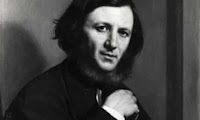
Robert Browning (1812—1889) is seen today, not only as one of the major poets of the 19th century, but as a celebrated romantic figure. He and the poet (then known as) Elizabeth Barrett eloped against her father’s wishes, escaping to Italy, where her health concerns had a greater chance of recovery.
It is for Robert Browning that Elizabeth wrote the famous sequence Sonnets from the Portuguese (his affectionate nickname for her, because of her olive complexion). This collection includes her Sonnet #43 — one of the most famous love poems of all time.
Robert Browning is particularly known for his lengthy dramatic poems — influenced by Percy Bysshe Shelley’s Prometheus Unbound, and in turn influencing such poets as Thomas Hardy and T.S. Eliot.
God, Thou Art Love
If I forget,
Yet God remembers! If these hands of mine
Cease from their clinging, yet the hands divine
Hold me so firmly that I cannot fall;
And if sometimes I am too tired to call
For Him to help me, then He reads the prayer
Unspoken in my heart, and lifts my care.
I dare not fear, since certainly I know
That I am in God’s keeping, shielded so
From all that else would harm, and in the hour
Of stern temptation strengthened by His power;
I tread no path in life to Him unknown;
I lift no burden, bear no pain, alone:
My soul a calm, sure hiding-place has found:
The everlasting arms my life surround.
God, Thou art love! I build my faith on that.
I know Thee who has kept my path, and made
Light for me in the darkness, tempering sorrow
So that it reached me like a solemn joy;
It were too strange that I should doubt Thy love.
*This is the third Kingdom Poets post about Robert Browning: first post, second post.
Entry written by D.S. Martin. He is the author of five poetry collections including Angelicus (2021, Cascade) ― a book of poems written from the point-of-view of angels. His books are available through Amazon, and Wipf & Stock.
Showing posts with label Thomas Hardy. Show all posts
Monday, February 14, 2022
Monday, July 22, 2013
John Keble
John Keble (1792—1866) is an English poet and churchman who held the chair as Oxford Professor of Poetry from 1831 to 1841. He was a significant influence on such poets as Thomas Hardy, Christina Rossetti and Matthew Arnold. His 1827 book, The Christian Year, may have been the best-selling volume of verse in the nineteenth century. He was also influential as part of the Oxford Movement: a group of Anglicans who sought to revive fading High Church traditions. In 1870 Keble College, Oxford, was named in his honour.
Although changes in literary fashion have undermined Keble’s popularity today — Malcolm Guite, in the introduction to his 2012 sonnet collection Sounding the Seasons, acknowledges his debt to The Christian Year.
Blest Are the Pure In Heart
Blest are the pure in heart,
For they shall see our God;
The secret of the Lord is theirs;
Their soul is Christ’s abode.
The Lord, Who left the heavens
Our life and peace to bring,
To dwell in lowliness with men
Their Pattern and their King.
Still to the lowly soul
He doth Himself impart;
And for His dwelling and His throne
Chooseth the pure in heart.
Lord, we Thy presence seek;
May ours this blessing be;
Give us a pure and lowly heart,
A temple meet for Thee.
Entry written by D.S. Martin. He is the award-winning author of the poetry collections Poiema (Wipf & Stock) and So The Moon Would Not Be Swallowed (Rubicon Press). They are both available at: www.dsmartin.ca
Although changes in literary fashion have undermined Keble’s popularity today — Malcolm Guite, in the introduction to his 2012 sonnet collection Sounding the Seasons, acknowledges his debt to The Christian Year.
Blest Are the Pure In Heart
Blest are the pure in heart,
For they shall see our God;
The secret of the Lord is theirs;
Their soul is Christ’s abode.
The Lord, Who left the heavens
Our life and peace to bring,
To dwell in lowliness with men
Their Pattern and their King.
Still to the lowly soul
He doth Himself impart;
And for His dwelling and His throne
Chooseth the pure in heart.
Lord, we Thy presence seek;
May ours this blessing be;
Give us a pure and lowly heart,
A temple meet for Thee.
Entry written by D.S. Martin. He is the award-winning author of the poetry collections Poiema (Wipf & Stock) and So The Moon Would Not Be Swallowed (Rubicon Press). They are both available at: www.dsmartin.ca
Subscribe to:
Posts (Atom)

