Showing posts with label Percy Bysshe Shelley. Show all posts

Monday, March 17, 2025

John Milton*

John Milton (1608—1674) is one of England’s greatest writers, and one who wrote during very tempestuous times. He was outspoken on political and ecclesiastical matters, when it was safer to keep such views to himself. His Areopagitica (1644) gained wide attention for his condemnation of censorship, and allied him publicly with the parliamentary cause.

As a Puritan he wrote tracts criticizing the High-church party within the Anglican establishment, while politically he criticized the government of Charles I. In 1649, after the parliamentary victory in the Civil War, Milton was appointed Secretary for Foreign Tongues by the Council of State. His role was to write in support of Cromwell’s government.

In 1660, at the Restoration of the monarchy, a warrant was issued for Milton’s arrest, his writings were burnt, and he went into hiding. He was briefly imprisoned, until influential friends, including Andrew Marvell, were able to have him released.

John Milton is revered as the author of Paradise Lost (1667) — his great epic about the Fall of mankind, and the hope of salvation through Christ. It became one of the most widely read works of English literature well into the Romantic period, influencing such poets as Blake, Shelley and Keats.

The Lord Will Come and Not be Slow

The Lord will come and not be slow,
his footsteps cannot err;
before him righteousness shall go,
his royal harbinger.
Truth from the earth, like to a flower,
shall bud and blossom then;
and justice, from her heavenly bower,
look down on mortal men.

Surely to such as do him fear
salvation is at hand!
And glory shall ere long appear
to dwell within our land.
Rise, God, judge thou the earth in might,
this wicked earth redress;
for thou art he who shalt by right
the nations all possess.

The nations all whom thou hast made
shall come, and all shall frame
to bow them low before thee, Lord,
and glorify thy Name.
For great thou art, and wonders great
by thy strong hand are done:
thou in thy everlasting seat
remainest God alone.

*This is the fourth Kingdom Poets post about John Milton: first post, second post, third post.

Entry written by D.S. Martin. He is the author of five poetry collections including Angelicus (2021, Cascade) ― a book of poems written from the point-of-view of angels. His books are available through Wipf & Stock.

Monday, August 21, 2023

Thomas Chatterton

Thomas Chatterton (1752―1770) is a poet from Bristol who was a forerunner and inspiration to such Romantic poets as Wordsworth, Coleridge, Shelly, and Keats ― all of whom commemorated him and his tragic death in their work.

Obsessed with the fifteenth century, Thomas Chatterton wrote inventive forgeries he claimed had been written by a fifteenth-century monk he called Thomas Rowley. He even produced complete manuscripts using techniques to distress the pages to make them appear old ― far more convincing than when children soak paper in tea for school assignments to make them look like old documents.

After he moved to London, he made little money. He wrote satires of well-known writers under a pseudonym, and often went without eating, although neighbours tried to have him join them for a meal. All of this led to his untimely death, and his mystique.

In many ways the myth of Chatterton mattered more to the Romantics than whatever might or might not be true. As a little-known poet, long-dead, who allegedly committed suicide shortly before his eighteenth birthday, he was held up as the Romantic ideal: literally a young, starving artist, who was misunderstood and ignored; some now suggest his death may have been from an accidental overdose of medication. Unfortunately, it seems he did not live up to the determination he expressed in the following poem.

The Resignation

O God, whose thunder shakes the sky,
Whose eye this atom globe surveys,
To thee, my only rock, I fly,
Thy mercy in thy justice praise.

The mystic mazes of thy will,
The shadows of celestial light,
Are past the pow'r of human skill,—
But what th' Eternal acts is right.

O teach me in the trying hour,
When anguish swells the dewy tear,
To still my sorrows, own thy pow'r,
Thy goodness love, thy justice fear.

If in this bosom aught but Thee
Encroaching sought a boundless sway,
Omniscience could the danger see,
And Mercy look the cause away.

Then why, my soul, dost thou complain?
Why drooping seek the dark recess?
Shake off the melancholy chain.
For God created all to bless.

But ah! my breast is human still;
The rising sigh, the falling tear,
My languid vitals' feeble rill,
The sickness of my soul declare.

But yet, with fortitude resigned,
I'll thank th' inflicter of the blow;
Forbid the sigh, compose my mind,
Nor let the gush of mis'ry flow.

The gloomy mantle of the night,
Which on my sinking spirit steals,
Will vanish at the morning light,
Which God, my East, my sun reveals.

Entry written by D.S. Martin. He is the author of five poetry collections including Angelicus (2021, Cascade) ― a book of poems written from the point-of-view of angels. His books are available through Wipf & Stock.
Monday, February 14, 2022

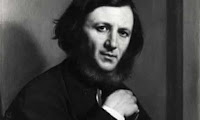
Robert Browning*

Robert Browning (1812—1889) is seen today, not only as one of the major poets of the 19th century, but as a celebrated romantic figure. He and the poet (then known as) Elizabeth Barrett eloped against her father’s wishes, escaping to Italy, where her health concerns had a greater chance of recovery.

It is for Robert Browning that Elizabeth wrote the famous sequence Sonnets from the Portuguese (his affectionate nickname for her, because of her olive complexion). This collection includes her Sonnet #43 — one of the most famous love poems of all time.

Robert Browning is particularly known for his lengthy dramatic poems — influenced by Percy Bysshe Shelley’s Prometheus Unbound, and in turn influencing such poets as Thomas Hardy and T.S. Eliot.

God, Thou Art Love

If I forget,
Yet God remembers! If these hands of mine
Cease from their clinging, yet the hands divine
Hold me so firmly that I cannot fall;
And if sometimes I am too tired to call
For Him to help me, then He reads the prayer
Unspoken in my heart, and lifts my care.

I dare not fear, since certainly I know
That I am in God’s keeping, shielded so
From all that else would harm, and in the hour
Of stern temptation strengthened by His power;
I tread no path in life to Him unknown;
I lift no burden, bear no pain, alone:
My soul a calm, sure hiding-place has found:
The everlasting arms my life surround.

God, Thou art love! I build my faith on that.
I know Thee who has kept my path, and made
Light for me in the darkness, tempering sorrow
So that it reached me like a solemn joy;
It were too strange that I should doubt Thy love.

*This is the third Kingdom Poets post about Robert Browning: first post, second post.

Entry written by D.S. Martin. He is the author of five poetry collections including Angelicus (2021, Cascade) ― a book of poems written from the point-of-view of angels. His books are available through Amazon, and Wipf & Stock.

Monday, September 3, 2018

Robert Browning*

Robert Browning (1812—1889) is as much celebrated for his romance with poet Elizabeth Barrett Browning as he is for his poetry. His first published book Pauline: A Fragment of a Confession was denounced by John Stuart Mill as being dominated by the poet’s personal emotions and self-consciousness; this critique may be responsible for Browning subsequently veiling himself from his readers in his dramatic monologues.

He was raised in an evangelical home, but briefly became an atheist after having immersed himself in the work of Percy Bysshe Shelley. This was short-lived, however, and after his marriage to Elizabeth Barrett Browning his Christian faith grew steadily deeper — although, like much of his private life, was not declared in a personal way in his poetry.

His extensive piece Christmas-Eve and Easter-Day is an examination of different attitudes towards Christianity, and is one of his most significant contributions from his married years (1846 to 1861). Robert and Elizabeth lived primarily in Florence. Her grave is in the English Cemetery there, and his is in Westminster Abbey.

from Christmas-Eve - X

Earth breaks up, time drops away,
In flows heaven, with its new day
Of endless life, when He who trod,
Very man and very God,
This earth in weakness, shame and pain,
Dying the death whose signs remain
Up yonder on the accursed tree,—
Shall come again, no more to be
Of captivity the thrall,
But the one God, All in all,
King of kings, Lord of lords,
As His servant John received the words,
“I died, and live for evermore!”

*This is the second Kingdom Poets post about Robert Browning: first post, third post.

Entry written by D.S. Martin. His latest poetry collection is Ampersand (2018, Cascade). His books are available through Amazon, and Wipf & Stock, including the anthologies The Turning Aside, and Adam, Eve, & the Riders of the Apocalypse.

Monday, October 20, 2014

Kevin Hart

Kevin Hart is an Australian poet, philosopher and theologian. He has published thirteen books of poetry, beginning with The Departure (1978). His poetry has received numerous awards such as the NSW Premier's Award, and the Greybeal-Gowen Prize. His most-recent collection is Morning Knowledge (2011). His earliest poetry influence was Percy Bysshe Shelley—particularly the poem "Ozymandius".

Hart is the Edwin B. Kyle Professor of Christian Studies and Chair of the Religious Studies Department at the University of Virginia.

The Room

It is my house, and yet one room is locked.
The dark has taken root on all four walls.
It is a room where knots stare out from wood,
A room that turns its back on the whole house.

At night I hear the crickets list their griefs
And let an ancient peace come into me.
Sleep intercepts my prayer, and in the dark
The house turns slowly round its one closed room.

This is the first Kingdom Poets post about Kevin Hart: second post.

Entry written by D.S. Martin. His new poetry collection, Conspiracy of Light: Poems Inspired by the Legacy of C.S. Lewis, is available from Wipf & Stock as is his earlier award-winning collection, Poiema.